Visitor Information
Table Of Content
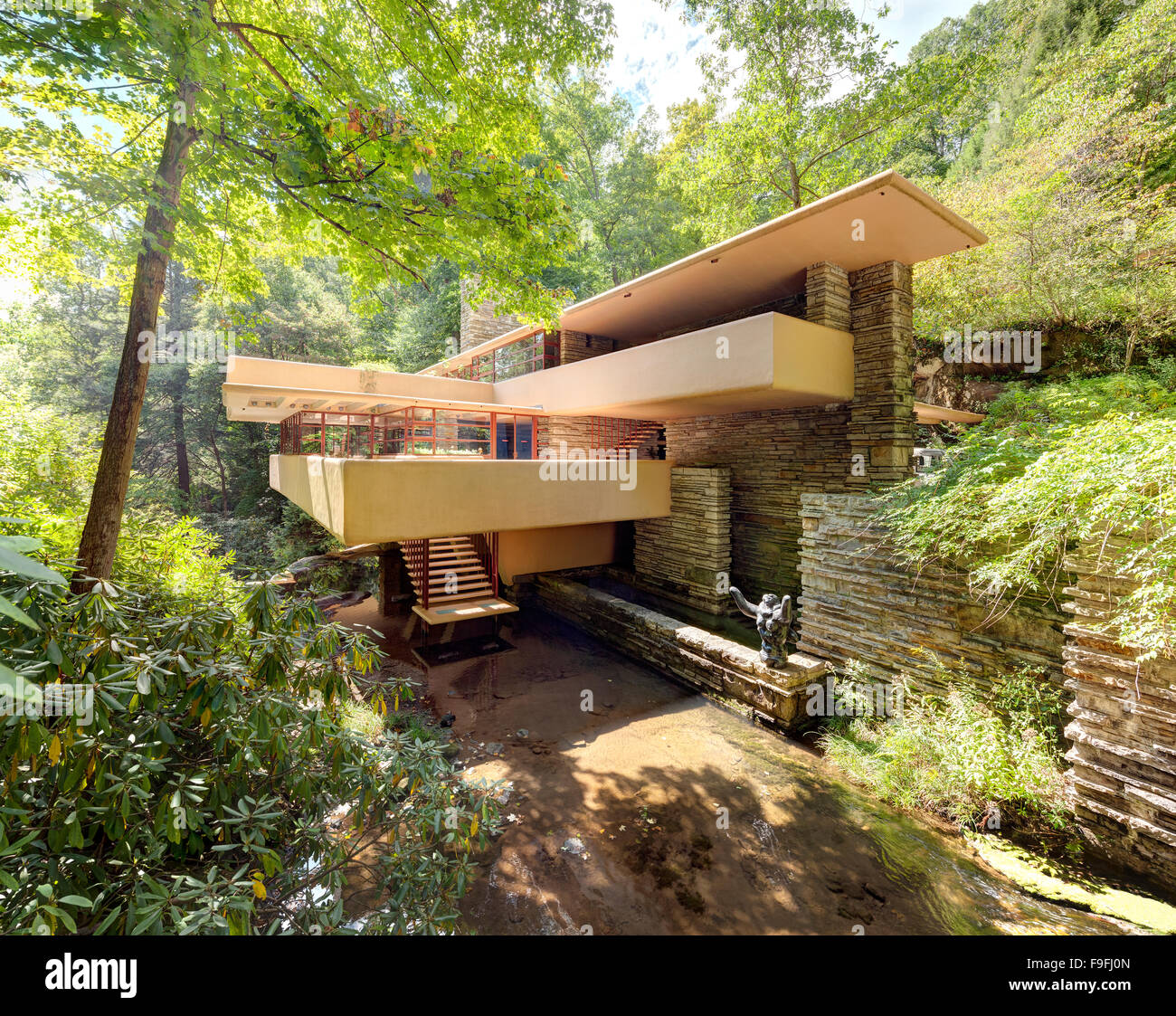
The steps of the “staircase of water” are suspended from traction cables, attached to the first slab. On the North face of the house, the opposite of that which “flies” over the river, there are two pergolas, like awnings, which run from the exterior wall to a stone incline and hang over the path which leads to the entrance. This means was utilised by Wright to make clear the respect for nature with which he designed the house.
Visitor Information
Many of these furnishings are made of North Carolina black walnut, a wood with warm chocolate tones, and veneered in sapwood. Wright found ample inspiration in this natural feature, whose cascading forms directly inspired the home's exterior. To reflect the look of the fall's jutting stone ledges, he opted “to cantilever the house from that rock-bank over the falling water,” resulting in the house's organically stacked appearance. And he got back to Taliesin and he wrote a letter to Kaufmann saying, “I’m designing a building to the music of the stream.” And the story that the building is telling is about how sound can in effect become part of the visual experience of architecture. And how the building therefore can exist in a temporal relation to its sight.
Focus Tour
In this room there is a bed and a staircase which leads to the viewpoint above the second floor. In the last room there is a window which extends down to the kitchen below. On the West wall of the office there is a door which leads to the terrace, through which two trees were originally intended to grow. A view of the full Grand Room, showing most of its windows and two of its seating areas.
to Fallingwater
Instead, Wright integrated the design of the house with the waterfall itself, placing it right on top of it to make it a part of the Kaufmanns' lives. The house was built as a weekend home for owners Mr. Edgar Kaufmann, his wife, and their son, whom he developed a friendship with through their son who was studying at Wright's school, the Taliesin Fellowship. UNESCO considers the international importance of a potential World Heritage Site based on its “Outstanding Universal Value,” which in the Wright series is manifested in three attributes. First, it is an architecture responsive to functional and emotional needs, achieved through geometric abstraction and spatial manipulation. Second, the design of the buildings in this series is fundamentally rooted in nature’s forms and principles.
5 Places to Enjoy Frank Lloyd Wright in the Laurel Highlands - Discover the Burgh
5 Places to Enjoy Frank Lloyd Wright in the Laurel Highlands.
Posted: Mon, 22 Apr 2024 07:00:00 GMT [source]
Frank Lloyd Wright’s Fallingwater: The Edgar J. Kaufmann House
As part of Road Trip 2010, CNET reporter Daniel Terdiman visited Fallingwater for the first time and was inspired and deeply impressed by what he saw. This philosophy guided the ins-and-outs of Wright's entire creative process. Fallingwater proved that Wright was not an outdated architect ready for retirement but an enduring visionary ready for the next phase of his career. Some of his most high-profile commissions came after, including the Guggenheim Museum in New York City.
Celebrating World Art Day April 15, 2024
This is the classic view of Fallingwater, taken from below the main house and looking back at it through an opening in the trees. Though the picture was taken in the summer, there are many photos taken from this spot that show Fallingwater in the winter, with all surfaces covered in snow, and the famous waterfall frozen in place. Through the feature, teachers can link to websites that give a biographical overview of the famous architect and his preference for architectural styles that reflect America’s democratic values and ideals. Or use interactive animation to learn more about construction forces and cantilevers . Today, Frank Lloyd Wright is regarded as one of American architecture's most influential figures. During his decades-long career as an architect and interior designer, Wright perfected a prolific number of designs, with his iconic Fallingwater at the forefront.
Timeline
Commissioned by the Kaufmann family in 1935 as a summer retreat, the house is perched over Bear Run, a picturesque site near Pittsburgh. Its design seamlessly integrates with the surrounding landscape, incorporating a waterfall to enhance Wright’s vision of organic architecture. The house seems to float above the cascading waters, creating a dramatic yet elegant dwelling that inspires architects and designers worldwide. Fallingwater, weekend residence near Mill Run, southwestern Pennsylvania, that was designed by American architect Frank Lloyd Wright for the Kaufmann family in 1935 and completed in 1937. The house’s daring construction over a waterfall was instrumental in reviving Wright’s architecture career and became one of the most famous 20th-century buildings. Fallingwater is located in the mountains of Southwestern Pennsylvania, also known as the Laurel Highlands, in Mill Run, Fayette County, which is about 70 miles southeast of Pittsburgh.
Fallingwater House – Discover Frank Lloyd Wright’s Architectural Style
When he was born, his mother accurately proclaimed that as her firstborn child, he would grow up to build magnificent buildings. She even went as far as decorating his nursery with drawings of cathedrals. The house was meant to compliment its site while still competing with the drama of the falls and their endless sounds of crashing water. The power of the falls is always felt, not visually but through sound, as the breaking water could constantly be heard throughout the entire house.
Guided Grounds Walking Tour
All of these furniture pieces were designed by Frank Lloyd Wright in 1937. Although not initially very interested in the material, the flexibility of it and the tensile strength that it provided when combined with reinforced steel made him change his mind. The facade windows were also designed specially to open up at the corners, opening up the house to the exterior even further. Frank Lloyd Wright was not only considered an architect, but also an educator, writer, and designer. Wright was known for designing organic structures that were in harmony with nature, working with nature rather than against it.
Critics raved after Fallingwater opened three years later, with Time magazine calling it Wright’s “most beautiful job” in a January 1938 cover story on the architect. Customized niches in the walls were also designed throughout the house to showcase the Kaufmanns’ extensive art collection. Wright incorporated custom built-in furniture to fit the space perfectly and for the character of the overall building to remain untouched by his clients or other designers. Wright was adamant about bringing nature inside the waterfall house through the use of very specific materials and finishes.
There was said to be a dispute between Kauffman and wright, as Kauffman wanted to add more reinforcement to the concrete, but Wright refused, he even went as far as threatening to resign from the project. By the time Wright was commissioned for Fallingwater, he was already 67 years old with very few commissions, as his prime overlapped with the Great Depression. Wright grew up on a farm, always surrounded by nature, which had an enormous impact on his design ethos. Wright had quite a difficult childhood, brought up very poor by a pastoral father and teacher mother. After Wright’s 14th birthday, his father and mother separated and, according to him, he never saw his father again.
Wright’s design suspended the home above the fall itself, filling the interiors with the powerful sound of rushing water. Participate in immersive and innovative programs that explore the intersection of art, nature and design. She received her B-tech degree in interior design from the University of Johannesburg in 2018 and has worked at various interior design firms since and had a few of her own freelance interior design clients under her company name binnekant. Kaufmann acted against Wright’s specifications and had more reinforcement installed.
Fallingwater opens to visitors for the season - CBS Pittsburgh
Fallingwater opens to visitors for the season.
Posted: Mon, 18 Mar 2024 07:00:00 GMT [source]
The main house came first, followed by the guest house, which is located just above, in 1938. Between the two buildings, there are 169 original pieces of furniture designed by Wright, one of the largest collections of the famous architect's furniture anywhere on Earth. Completed in 1938, Fallingwater, designed by the American architect Frank Lloyd Wright, is a timeless masterpiece of organic architecture.
The ground in parts of La Paz County has dropped more than five feet during three decades of farming. All-Access VIP admission starts at $119, which includes admission into the exclusive and luxurious Paradise Adult Island, Bliss Pool, and the swim-up bar. Members of the military and Atlantic City’s first responders received a $10 discount. In the interior of the Fallingwater House we find rooms which are unique in their distribution, location and finishes.

In Fallingwater, Wright anchored a series of reinforced concrete “trays” to the natural rock. Cantilevered terraces of local sandstone blend harmoniously with the rock formations, appearing to float above the stream below. The first floor entry, living room and dining room merge to create one continuous space, while a hatch door in the living room opens to a suspended stairway that descends to the stream below.
The idea of cantilevering the floors from a center point was inspired by pine branches. The square footage of the terraces of the house is almost the same as that of the indoor areas. To further emphasize the significance of the fireplace, the chimney is dramatically so, the highest point of the exterior of the house. The rooms were furnished by Wright himself and are very simple and minimalistic. The passageways in the house are very dark and narrow and they were purposely designed this way by Wright to further emphasize the expansion of the open-plan areas.


Comments
Post a Comment